中文
中文 English
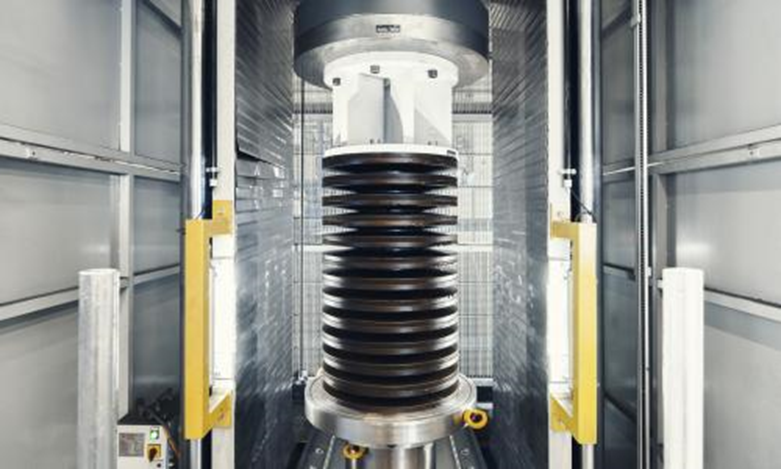
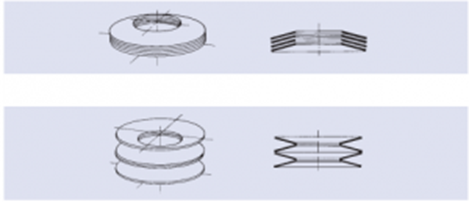
Top: Parallel disc spring stack. Bottom: Series dished spring pile.
LESEI disc springs are used as modular components. A group of single dish springs stacked in the same way is called a parallel spring stack. A group of single dish springs stacked in an alternating manner is called a tandem spring stack. Dish springs can be combined in a number of different ways, stacking in parallel, in series, or a combination of both. In a parallel spring stack, the deflection of a stack is equal to the deflection of a single spring. The load at a given deflection is proportional to the number of individual springs in the stack. In a series spring stack, the deflection of the stack is the sum of the deflection of the individual springs. The load on the stack is equal to the load on a single spring.
A progressive characteristic load curve can be obtained by using parallel stacks with different numbers of combinations of disc-springs to produce a composite series stack (high friction) or a series stack consisting of individual disc-springs of different thicknesses and total heights (low friction). Progress is achieved because the weaker stack - or weaker spring - is cancelled out and therefore no longer contributes to the compression of the stack after a flat position or deflection limiter is reached.
The following criteria should be considered in the design of dished spring groups:
• If the deflection of individual springs is insufficient, use single springs stacked in series.
• If high loads must be obtained within limited mounting space, use single springs stacked in parallel.
• Larger spring diameters allow for lower overall height.
• Generally, there should be no more than 4 springs stacked in parallel, as the difference between calculated and measured characteristic load curves increases with the number of multiple disc springs due to friction.
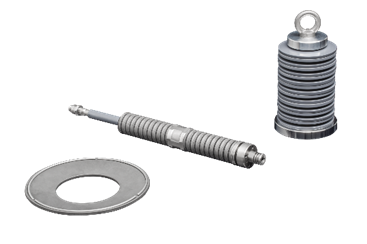
Both series and parallel dished spring sets should be guided. This is done by means of rods, sleeves, self-centering devices, or hardened line segments. Internal and external guides shall be polished over the entire length and hardened to at least 55 HRC. Unhardened guides can be used in purely static or minimally alternating loads. In the LESEI dish-spring pile, loads can be applied through the inside or outside diameter. If the load is applied through the bore, the contact pressure will be higher.
Internal and external guides require some clearance between the spring set and the guide element. This leaves enough room for the lubricant to shift while ensuring proper guidance.